Energy Local Totnes

ENERGY LOCAL TOTNES

THE FACTS AND FIGURES

What: Energy Local Totnes; a club for buying and selling locally generated renewable electricity at a fair price
Where: Within the Totnes Substation
Why we love it: A chance for local residents and businesses to buy green local energy at low cost
Total installed capacity: Est. 400 kWh
Average annual generation: Est. 400,000 kWh

Member Household Electricity Bill Reduction Target:15-30% per year

Member Household Carbon Emissions Reduction Target: 30% per year

Status: £25,000 grant received March 2022 to scope out the project, from Team Devon’s COVID-19 Economic Recovery and Business Prospectus Funding. £120,000 grant received September 2023 to develop the club in the consumer market, from the Energy Saving Trust’s Redress Scheme.

What

Energy Local Totnes (ELT) is a club for buying and selling locally generated renewable electricity at a fair price, saving customers money off their bills, and paying small local renewable generators a little bit more for their excess generation.

Our modelling suggests that the average household – ie, a 2-3 bedroom house with average electricity consumption – will save 15% off their bill. But if they are able to shift the times of their demand and use the electricity when it is generated, then they could save up to 30%.


Who

TRESOC are starting the club with the renewable electricity generated by the 330kW Hydro power plant on Totnes Weir, the majority of which is owned by Dart Renewables, with a small percentage owned by TRESOC and TRESOC members individually.

The green electricity will be sold to 100Green, who then sell it to Energy Local Totnes. Because it is being sold locally, within the Totnes Substation, it can be sold at a cheaper rate. The current match price, which is the price that customer pay is 15p/kWh.

To take part in the club as a generator or a consumer, participants need to be within the Totnes Substation. This is larger than it sounds, and includes Totnes, Dartington, Ashsprington, Littlehempston, Harberton, Harbertonford and Halwell. They will also need to have or be willing to have a smart meter installed. Households and small businesses are able to become members.


Area Covered by Energy Local Totnes


Why

Totnes Renewable Energy Society (TRESOC) are working in collaboration with Energy Local CIC and 100Green (Formerly Green Energy UK), to develop Energy Local Totnes. Energy Local CIC have previously established 8 other Energy Local clubs across England and Wales. The project, so far, has been grant funded: it received seed funding from Devon County Council’s Post Covid Economic Recovery Fund and a REDRESS grant from the Energy Saving Trust (EST), to further develop Energy Local Totnes (ELT) over the next 2 years.


How

A key aim of the project is to keep the economic benefits of renewable energy within the local economy and provide residents and small-scale generators with some protection from fluctuating external markets. However, the long-term aim is to be able to lift local people out of fuel poverty by providing low-cost electricity. The first year of the project will be a trial to ensure that we can actually reduce people bills, and then we hope to invite people on low incomes to take part.


When

The club will go live over the next month. We have 8 households who are patiently waiting to switch onto the Energy Local Totnes tariff with 100Green. It takes about 3 weeks for the full switch to take place. The next round of customers will be accepted towards the end of the summer.

Initially the club will start small, however, we aim to connect 200 households in the next 2 years. The club will continue to grow as new generators join, as the number of customers must be balanced by the amount of generation. TRESOC have a planned pipeline of community-owned rooftop solar PV projects, that once installed will sell their electricity into the club.

Tariff Rates

These charges apply once you are on the Energy Local tariff.

Electricity Standing Charge

63.35p/day

Match Tariff

15.00p/kWh

Time of Use Tariff

12am – 7am all week
15.71p/kWh

4pm – 8pm weekdays
36.19p/kWh

All other times
23.83p/kWh


Interested in taking part?

Local people who want to buy their electricity from ELT need first to sign up or register their interest through the Energy Local website, then they will be instructed in how to switch their energy supply company to 100Green, and onto the Energy Local Totnes Tariff. To join the ELT club, you will need to be within the Totnes Substation and have – or be happy to have – a smart meter fitted. If you are interested in joining the club, please register your interest on the Totnes club page of the Energy Local CIC website.


Energy Local Plus Model

Energy Local have established several similar projects across England and Wales. This will be the first that will continue to grow, as new generators and customers join, continuing to support the growth of community renewable energy, while reducing peoples’ bills and greening the local economy. This new business model is called Energy Local Plus or EL+.
Once this new business model has been demonstrated in Totnes, it will spread to other places and has the potential to catalyse some real systemic change, making the energy system more equitable as we transition to a green economy.


Benefits of Selling Energy Locally

Buying and selling renewable energy locally has many economic, social, and environmental benefits:
· The community benefits from buying energy more affordably, helping to reduce fuel poverty
· Small local generators receive a decent export rate for their excess energy and more control over pricing
· Profits are retained by the local community, supporting the local economy
· Fairer export prices mean more local renewable energy projects become commercially viable for households, communities, and businesses, which acts as an economic driver for more renewable energy development and a gradual greening of the local economy
· Local renewable energy resources make the community more energy secure, self-reliant, and resilient, as energy prices are decoupled from volatile international markets
· The environment benefits as consumers reduce their reliance on fossil fuels and reduce carbon emissions
· Buying renewable energy from local places make consumers feel more connected to energy supplies and fosters energy responsibility
· Balancing local supply with demand helps the national grid reduce the need for costly network upgrades
· Less electricity is wasted through transmission losses, as the distance from supplier to customer is shorter


Developing ELT

A Redress Energy Grant from the Energy Saving Trust (EST) will support the growth of ELT in the local domestic market, including member education on shifting energy demand and energy use, evaluation of the Energy Local Plus model, knowledge dissemination, and the replication of the model. The University of Plymouth will independently review the business model and its replicability.

ELT objectives are as follows:

· To develop Energy Local Totnes by signing up 400kW of locally generated renewable electricity into the club (25% new generation) balanced by 200 plus households in the first 2 years
· To save household members between 10 – 30% off their energy bills and to reduce their carbon emissions by a target of 30% (the amount of carbon savings will be dictated by the energy mix of their previous supply company. If their previous energy company supplied 100% green electricity, then the savings would be smaller)
· To engage all 200 household members in workshops on energy consumption reduction and demand shifting to maximise the use of local renewable electricity
· To investigate the benefits and viability of using storage within a club – especially with predominantly solar generation – and its role in managing network constraints to help install more generation
· To evaluate the financial, environmental, and social viability of a local renewable energy market, using the Energy Local Plus model (EL+). This will cover the direct economic savings and carbon emissions of the households in the ELT club based on their use over the course of a year and their previous tariff and supply company. This research and evaluation will be directed by Professor Ian Bailey, University of Plymouth, and carried out by a master’s student on the Sustainable Environmental Management MSc
· To share the Energy Local Plus model nationally with other community energy organisations through knowledge dissemination: improving the Energy Local website and materials; a 4-minute video; a case study PDF; events and workshops
· To replicate the model by training 10 more Energy Local advisors and establishing, to the point of operation and including incorporation, 2 new EL clubs (in addition to ELT)
· To engage the next generation in community-scale energy through pre-school and primary school renewable energy education programmes
· To examine the potential for EL+ clubs to provide additional income streams for people on low incomes who have had solar PV installed as part of the ECO Grant scheme


Clay Park Solar PV

CLAY PARK

Project Update

TRESOC has created this video to explain and reflect on our role within the Clay Park project collaborating with Transition Homes CLT.
We’re grateful to the Rural Community Energy Fund for their support in helping us investigate and develop the Clay Park project. Their grant allowed us to showcase a new business model where a community energy company and a local housing developer could generate low-cost green electricity for affordable housing.

Although our involvement with the Clay Park project is coming to an end, we remain committed to developing the microgrid model through our Energy Local Totnes project. We hope our work will inspire other community energy groups to plan their own microgrids and help transition to an equitable low-carbon future.

THE FACTS AND FIGURES

Who: Transition Homes Community Land Trust (THCLT)
Where: Clay Lane, Dartington
Why we love it: Providing low cost energy to people in a unique housing development built to meet local housing need
What: 720 roof-mounted solar PV panels – 180 kWh total
Average annual generation: 180,000 kWh of electricity per year
CO2 equivalent per year*: Reduces CO2 emissions by about 45 tonnes per year
Status: 2nd grant from Rural Community Energy Fund received to take project to point of raising share capital

Original Project Roadmap

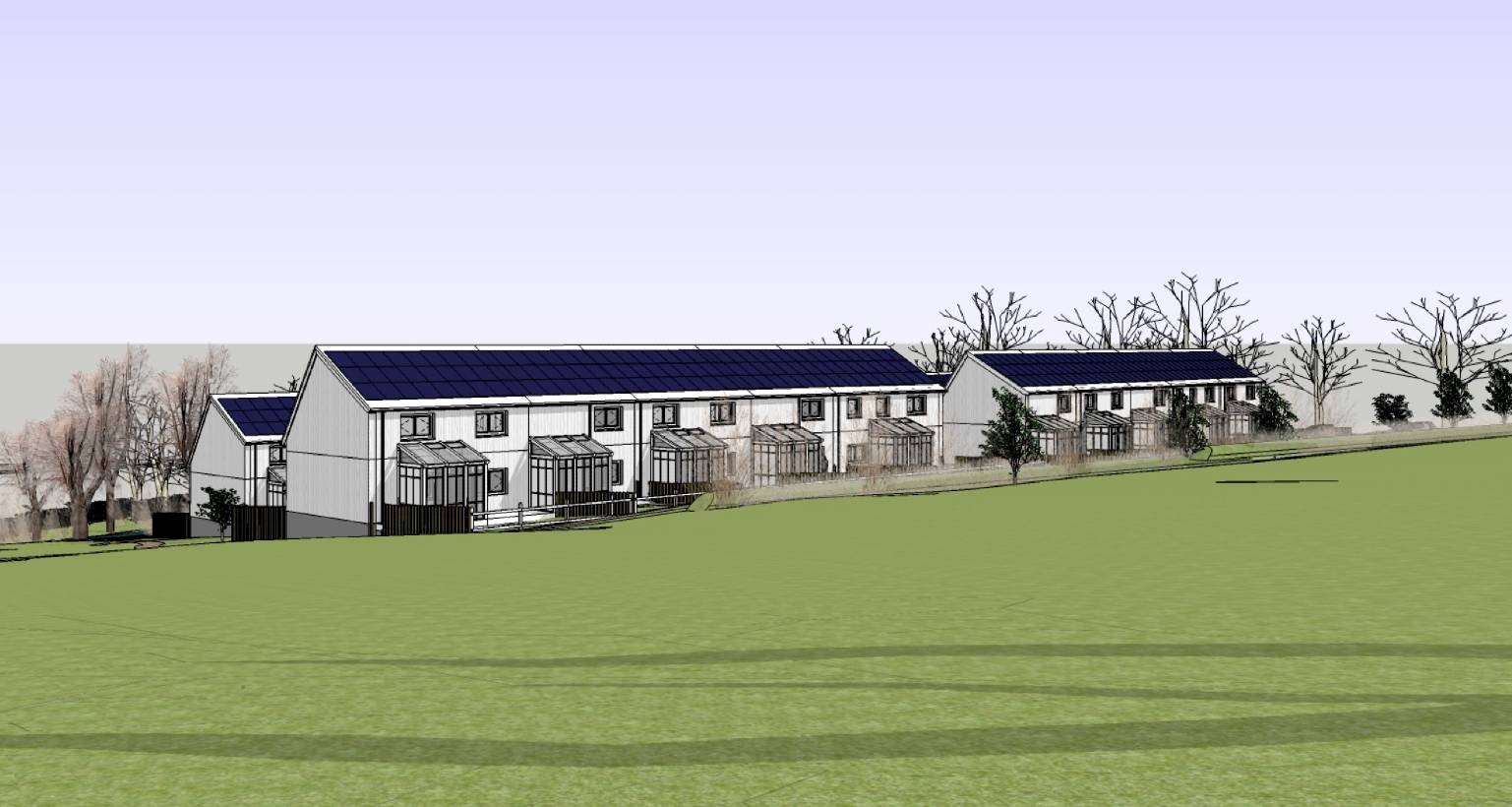
TRESOC have been invited by Transition Homes Community Land Trust to own, install and operate 180kW of solar PV on their Clay Park Eco-Housing Development. TRESOC will become the energy supplier for the mini-grid providing the site with 100% green electricity. In 2019 we received a grant from the Rural Community Energy Fund for £88,000 to enable us to do the development work to bring the project forward. The development work determined that the economic case for TRESOC’s involvement was sound, and enabled us to design a system that maximises the use of the onsite solar, using batteries and electric car charge points. We also proposed a monitoring system to show TRESOC when the solar electricity is being used versus the mains electricity. We undertook an extensive community engagement programme  throughout the summer of 2020 – some of it online due to the Covid 19 pandemic – and provided educational projects for Totnes Schools KEVIC and the Grove.

In 2021 we received a Stage 2 Development Grant from RCEF for £79,000. This will pay for the technical, legal, financial and community engagement work needed to take the project to the point of being finance ready. Jon Rattenbury, Programme Manager for the SW Energy Hub, said: “Innovative projects such as this prove how much community initiatives can achieve in the energy space and the vital role projects like these play in the transition to net zero.”

The grant will help us demonstrate an economically viable community business model for providing solar PV on housing estates that can be shared with other community energy groups, and the energy sector more widely. Part of the grant is specifically for knowledge sharing and dissemination, and TRESOC have waived any intellectual property rights. TRESOC are a member of the Devon Community Energy Network and has encouraged the establishment of a microgrids working group to facilitate this knowledge sharing. There are several local community energy groups exploring microgrids, who will be able to share the Clay Park legal and technical templates, greatly reducing their own development costs.

Once the scheme is investment ready, TRESOC will release a community share-offer to finance it. Please sign up to the Friends of TRESOC mailing list for updates, by emailing admin@tresoc.co.uk.

Shine Social Housing

SHINE SOCIAL HOUSING

THE FACTS AND FIGURES

Who: South Devon Rural Housing Association (SDRHA)
Where: 42 properties across the region
What: 607 solar panels
Size: 151.74 kW total
Makes: 148,000 kWh of electricity per year
Average equivalent saving: reduces CO2 emissions by about 85 tonnes per year.

We notice a real difference in the summer and pay half as much as before. I am on a key meter so it is easy to monitor in terms of time between top-ups.”

Cheryl Usher-Philipson, Shine solar recipient.

Outcomes and benefits

Expected annual generation will be 148,000 kWh.  CO2 equivalent avoided by the use of clean energy will be 71,000kg or 71 tonnes per year.*

If Shine residents are paying 15p/kWh and they use half of the PV electricity (the assumed norm), then, in total, they would be saving £13,338 per year.  If they use all the PV electricity they would be saving £26,676. Actual savings are probably somewhere in between.

* Based on Defra – average of 2014 & 2015 numbers.

The Shine Project | Social Housing Initiative for New Energy


The Shine Project is the result of a partnership between South Devon Rural housing Association (SDRHA) and TRESOC. The project was completed in 3 phases and took almost 2 years to complete. In 2015, TRESOC was awarded RegenSW’s ‘South West Green Energy Award for the Best Community Initiative’ for the Shine Project.

Lower electricity bills for SDRHA residents
The result is solar PV on the roofs of 40 SDRHA homes across the region, from Plymouth to Exeter, concentrated in Totnes and Dartington – which means cheaper electricity bills for tenants and welcome relief from rising energy prices. And thanks to SDRHA, the majority of properties also receive a device for solar-heated hot water. The project includes arrays on Forder Lane House and a 25-bed care home and SDRHA’s HQ (also home to Devon County Council’s Totnes Work Hub).

Local roots
SDRHA was established in 1958 and its purpose at that time was to provide housing for staff retiring from work on The Dartington Hall Trust’s country estate. The Association has evolved over the years into a strong, community-based organisation for South Devon.

Local business and jobs
Totnes company Beco Energy Solutions completed the survey work, installation, project management and customer care throughout the project. Another local company, Argand Solutions, is working with generation data from this project to develop their energy data analytics platform (Energy Lenz).

Using local investment capital to buy, install and maintain the panels means that profits from the scheme will go back into local people’s pockets, and back into the local economy.

Participant feedback


After Shine Phase 2 was complete, we asked 21 participating tenants to fill in a short survey about their experience with the Shine Project.  10 people returned the survey.

  • 9 out of 10 survey respondents reported having a positive attitude towards PV.
  • 7 out of 10 people were happy or better with the solar system once it was up and running.
  • 6 out of 10 people claimed to have changed the way they use electricity since the panels were installed (we provided printed information and talked through the process with everyone).
  • 7 out of 10 people reported changes in their energy bills (i.e. they could see a reduction).

It’s a fair assumption to say that the process raised awareness of electricity use patterns with most people.  As time passes, we expect to be able to see some clearer ‘before & after’ data.

“TRESOC’s community investment model is allowing us to benefit a large proportion of our tenants simply because TRESOC can operate at scale. The fact that SDRHA tenants will benefit directly from lower electricity bills, and TRESOC’s local members will benefit from Feed in Tariff income is ideal.  And, not investing our capital in retrofit solar means that we can continue to explore other renewable energy technologies, allowing us to look to the future. It’s a perfect model for any housing association. Local money, local investment, what’s not to like?”

Steve Prime, SDRHA CEO

“This project clearly shows how TRESOC can use local investment capital to benefit the local economy and to support people in our community potentially at risk in terms of fuel poverty”

Ian Bright, TRESOC MD

PROJECT GALLERY

Hatchlands Farm

HATCHLANDS FARM

THE FACTS AND FIGURES

What : 203 roof-mounted solar PV array on farm building at Hatchlands, providing low-cost electricity to the farmer, with an excess exported to the grid.
Why we love it: Already generating electricity and investment-ready for immediate income. Great model for community investment in farm buildings. An ideal alternative to groundmounted arrays.
Total installed capacity: 49.9 kWp
Average annual generation: 50,229 kWh [FiT rate as of Nov 2011: 34.5p gen, 4.5p export]
Est. annual net income to TRESOC: £17,000
CO2 equivalent per year*: 24 tonnes
Customer equivalent per year**: 12 families’ typical use
Purchase price: £168,000 + transaction costs + VAT
Status: Commissioned in November 2011. Long term lease in place with landowner to 2036; 25 year FITs and lease. We have carried out due diligence on the performance of the system, and negotiated a price with the developer to give a return on investment of 9%.

View here the 2017 Performance Study of the Hatchland’s Solar Array [provided by Intern, Robert Weinhold].

Hatchlands Farm

Hatchlands Farm sits just off the Plymouth Road about 5 miles west of Totnes. TRESOC were involved in helping to develop this project with installers South West Solar Projects a few years ago. It is now installed as a 49.9kWp system which was offered to us at a negotiated price earlier this year, and would increase our overall capacity and returns.

There is a market within the area for profitable renewable energy generation via sub-50kw solar PV installations on existing agricultural buildings, although many of these opportunities have been pursued privately. Roof-mounted panels on large, stable roofs provide the ideal electricity generating scenario for community development or investment.

Staverton Leat

STAVERTON LEAT

THE FACTS AND FIGURES

What: Archimedes Screw on the Dart
Where: Staverton
Why we loved it: An exciting project with encouraging estimated returns, that built on our working relationship with Hydrosense.
Total Installed Capacity: Est. 100 kW
Average Annual Generation: Est. 360,000 kWh
CO2 equivalent per year: 162 tonnes
Customer equivalent per year:  109 families typical use
Est. annual Income to TRESOC: (2% share): £6,000
Total Project Cost: Est. £916,000


Staverton Hydro Community Benefit Society to be dissolved

Between 2014 and 2020 we were co-developing a small-scale 100 kW hydro power plant at Staverton leat in joint venture with Hydrosense, developers of the scheme at Totnes Weir. To do this we set up a separate, project-specific ‘BenCom’: Staverton Hydro Community Benefit Society. Agreements were in place with the Staverton family who own the land where the leat is located and with Dartington Hall Trust, who would have received the electricity generated.

As of 2021, the Staverton Hydro Community Benefit Society is to be dissolved. With generous support from the Rural Community Energy Fund, SHCBS was able to carry out a feasibility study and to prepare and submit a full planning application to the local planning authority for a single hydro turbine on the leat at Town Mills, Staverton. Expert discussion on the Habitat Risk Assessment with the Environment Agency and Natural England in 2019 focused on the conservation status of salmon in the Dart. The conclusion of the EA was that they could only permit abstraction of water during a three month period from January to March to avoid the possibility of damage to migratory salmon and sea trout. This would mean that the financial return from electricity generated could not repay investment in the scheme. Following this decision the TRESOC Board has decided to dissolve the Society and is now in the process of doing so. However, we are grateful to everyone who supported this project for so long and hope it may yet be realised at a later date.

We had confidence in this project because there is an historical precedent—the plant once generated electricity for the Dartington estate in the 1930s (see the story below).  Also, the local developer, Hydrosense, has a successful track record of similar hydro projects which satisfy many stakeholders (Environment Agency, planners, anglers, neighbours and others), and we know the river flow in the Dart offers an excellent opportunity for generation from the work done for the Totnes Weir hydro scheme, and from the data from the very first Archimedes screw turbine in the UK at River Dart Country Park. Co-development of the project also offered a much higher projected rate of return.

In addition to generating electricity from a single Archimedes turbine, the project would have regenerated the leat, which has fallen into disrepair, with a new fish pass and smoult pass to help up- and down-stream migration of river life.

Back in June 2014, TRESOC met with Hydrosense, the landowners, Parish Council members, local residents, representatives from the Environment Agency and the Dart Anglers Association to progress the Staverton Leat hydro project. The meeting was very positive, with all present in favour of the scheme. During the meeting, Julian Sharpe of the Dart Anglers Association said, “I am very, very keen to see this scheme happen, and my beloved fish protected.” A member of the Staverton Leat Working Group said, “This is the best answer to our problems”.

Staverton Hydro Community Benefit Society (SHCBS) was set up by TRESOC specifically to develop the Staverton Hydro project. In June, 2017 a £20,000 grant from the Rural Community Energy Fund (RCEF) was awarded to kick start the development of the 100kW hydro power plant at Staverton Leat. SHCBS used the grant to do a feasibility study and part was also used for outreach work to engage the local community. This included a series of August, 2017 Walk & Talks to visit the project site and, the ‘REEL‘ programme piloting at St. Christopher’s School, Staverton.

You can read a press release, as Planning Application was submitted [October, 2018], and the Rural Community Energy Fund’s Feasibility Report [January 2018).

Staverton Leat  |  The History

In June 1930, Dorothy and Leonard Elmhirsts’ daughter Ruth, aged four, flipped a switch and formally started up a new hydro station to bring hydro-electric power up to the Dartington Estate — a J. J. Armfield water turbine installed within Town Mills, near Nappers Crossing at Staverton leat. Town Mills, which was leased from the Church Commissioners by Dartington’s trustees, was previously a corn mill built over Staverton leat.

In those days, electricity to this area was controlled by Torquay Borough Corporation. They had advised the Elmhirsts when they bought the estate in 1925, that the Hall and village were too remote to have a mains supply. With his appreciation of small scale electricity generation, Leonard Elmhirst moved forward with plans to convert Town Mills, into an ‘automatic turbo electricity generator’.

From 1932 to 1942, the plant provided electricity to Staverton Builders, but wartime production proved too demanding. Staverton switched to the mains and the trustees were ready to scrap the plant. However, the estate’s electrician, Frank Christy, was able to make the modifications necessary to overcome the technical obstacles. He also successfully conducted the high diplomacy needed to enable the plant to be run in connection with the Torquay supply.

The plant produced power for forty years via its two turbines (15kW and 35kW). Dartington took the electricity it needed and more if necessary, although by the late 60s the plant was primarily serving the Hall area. In the early 70s, the plant was closed down. Town Mills was bought at auction by Nigel Amherst, a member of staff in the music department at Dartington College of Arts and it remains the private residence of the Amherst family.

(Thanks to the staff of The Totnes Archive, part of Totnes Museum for this information)

Read our two further oral history case-studies, where Tresoc Intern Lawrie speaks to two local families about their Staverton memories and the history of the original leat and turbines.

PROJECT GALLERY

Lescaze Solar Array

Lescaze Solar Array

Listed 30s building goes solar in local partnership.

THE FACTS AND FIGURES

Who: Lescaze Offices, Dartington Hall Trust.
Where: Lescaze House, Shinner’s Bridge, TQ9 6JE
What: 120 roof mounted solar pv panels
Size: 29.9kW
Commissioning Date: 2016.
Makes: 28,000kWh/yr
Customer Equivalents: 6.7 average typical houses
Average equivalent saving: 13.5t/yr

William Lescaze offices have new 30kW solar PV array.

A partnership between The Dartington Hall Trust and TRESOC, working with Beco Energy Solutions.

A new 30kWh solar-PV array has been put on the roof of the Lescaze Offices in Dartington village to provide renewable electricity.

Ian Bright, managing director, TRESOC, says: ‘We’re delighted to be working in partnership with Dartington to produce low cost green electricity for key stakeholders, high value employment in local businesses and a sustainable financial return on local community investment.’

You can read the full press release from The Dartington Hall Trust here.

PROJECT: GALLERY

Totnes Weir

TOTNES WEIR

THE FACTS AND FIGURES

What: An equity stake in a twin Archimedes Screw Hydro System and new fish pass
Where: at Totnes Weir, developed by Hydrosense.
Why we love it: Fantastic landmark scheme with widespread support. Local water supply pumped using energy from the river. Win-win for clean energy and spawning salmon & sea trout. Great partnership arrangement with developer and community.
Total installed capacity: 300 kWp
Average annual generation: 1,250,000 kWh
CO2 equivalent per year: 597.5 tonnes
Customer equivalent per year: 333 families typical use * Estimate based on the most recent statistics from the DECC showing that annual UK average domestic household consumption is 4,115 kWh.
Est. annual income to TRESOC: (21% stake): £37,500
Total cost: £500,000 to buy a 21% stake in the project.


TOTNES WEIR

The Totnes Weir Hydro power plant was constructed in 2015 and began generating electricity in December 2015. It has been performing ahead of expectations with electricity generated being higher than forecast.

Designed to withstand at least a one in 100 year flood and the additional impact of high spring tides and increased river levels due to climate change, the scheme has coped admirably with recent storms.

Two Archimedes Screw turbines are generating clean, renewable electricity for Totnes.  The scheme is expected to generate around 1,250 MWh of clean electricity each year – enough to power around 300 homes for at least 40 years*.

A new best practice fish pass has been installed adjacent to the turbines to allow more salmon and sea trout to migrate past the weir and spawn in the Dart catchment.  An automatic fish counter has also beed installed to monitor the number and sizes of fish using the pass.  Extensive research has proven that fish can pass through the slowly rotating turbine with no adverse effects.

A recreational area is being created near the turbine house with information about the scheme and a new canoe launch platform has been created.

Tresoc now participates the Annual Archimedes Screw Festival at the Totnes Hydro Weir, organised by The BioRegional Learning Centre.

* Estimate based on the most recent statistics from the DECC showing that annual UK average domestic household consumption is 4,115 kWh.


PROJECT: GALLERY

Follaton Community Centre

FOLLATON COMMUNITY CENTRE

THE FACTS AND FIGURES

Who: Follaton Residents Association Ltd.
Where: Whiteley Avenue, Totnes, Devon, TQ9 9BJ
What: 28 solar panels
Size: 7 kW
Commissioning Date: 26/06/2013
Makes: 6,009 KWh of electricity per year
Customer Equivalents: the yearly electricity demand of 2 typical families
Average equivalent saving: reduces CO2 emissions by about 2.9 tonnes per year.


OUTCOME AND BENEFITS

In terms of an investment for our members, the FiT rate for this installation is 14p / kWh for total generation, plus 4.5p for deemed export on 50% of total generation, index linked, and we are expecting to earn around £1,100 per annum (2013 rates).


The Community Hall  |  Follaton Residents Association

The Community Hall is the main facility of the Follaton Residents Association, which also manages play areas and open space on the Follaton estate in Totnes.  The Community Hall is home to Follaton Community Cinema, which was created by Follaton residents with borrowed equipment in 2011 to show great films – and, more importantly, to bring together people from across the area. After receiving some funding, the cinema now has state-of-the-art cinema equipment and prides itself on creating the full cinema experience – plus a few community touches, like homemade cakes!

We are happy to have contributed to the reduction of operating expenses for this venue, where many classes and activities take place, such as Kung Fu “Dragons”, yoga, flower arranging, kids parties, ‘Crawlers & Climbers’ and the Alzheimer’s Society’s ‘Singing for the Brain’.

Leatside Surgery

LEATSIDE SURGERY

THE FACTS AND FIGURES

Who: Leatside Surgery
Where: Babbage Road, Totnes, TQ9 5JA.
What: 114 solar pv panels
Size: 27.4kW
Commissioning Date: completed 2012.
Makes: 24,000kWh/yr
Customer Equivalents:  5.7 average typical houses
Average equivalent saving: 11.5t/yr


The Leatside Surgery

Leatside’s solar PV system is the result of a partnership between Totnes Renewable Energy Society and Yokk Solar Ltd, in collaboration with Leatside Surgery.  The panels were engineered and installed by Yokk, and financed and owned by TRESOC for the benefit of the Leatside building owners, staff, patients, and TRESOC members, plus the community at large in terms of CO2 reduction.  With 14,000+ registered patients, the savings gained for the surgery can be channelled into patient care.

In addition to the surgery’s electricity bill saving, TRESOC members’ investment of £39,000 will earn a return of around 9% over the 20 year lifespan of the project through FiT payments on all electricity generated by the panels, regardless of whether its used by the surgery or exported to the grid, plus a deemed export.  As our Director of Engineering, Mandy Burton says, “This is an important milestone for TRESOC that our members can be very proud of – our first live project.  The display panel in the lobby will show you how much is being produced right now, and the total energy produced and carbon saved since they were installed.”

Looking to the future, Leatside’s Strategic Business Manager Janine Payne told us, “We look forward to seeing the panels generate savings for Leatside Surgery over the years to come.”

PROJECT: GALLERY

Sowton Weir

SOWTON WEIR

THE FACTS AND FIGURES

What: An equity stake in an operating single Archimedes Screw
Where: on the River Teign near Chudleigh, designed and built by Hydrosense.
Why we love it: Already generating electricity and ready for investment. Increases in migratory fish population in the upper Teign as a result of new fish pass installed with the project.
Total installed capacity: 100 kW Average annual generation: 368,000 kWh CO2 equivalent per year: 165 tonnes
Customer equivalent per year: 112 families’ typical use
Est. annual income to TRESOC (30% stake): £13,800
Total Cost: £200,000 to buy a 30% stake in the project
Status: Commissioned in October 2013


Sowton Weir

We have signed an agreement to invest £200,000 in the recently constructed 100 kW hydro power plant at Sowton Weir on the River Teign. Like the Hatchlands Farm solar roof, income will begin to accrue as soon as the purchase is made, with an internal rate of return to TRESOC of around 7% per annum. As with our estimates for Totnes Weir we have calculated returns over a 30 year-period rather than the full period of the lease to exercise some caution in our estimates. Effective optimization at the site has led to better than expected returns from the project. The generation meter readings have been matched to flow data to show that the system is producing slightly more electricity than predicted. Although exact numbers are hard to predict, there may be an increase in fish populations of 10 to 30% over the next 3 to 5 years.

The Archimedes at Sowton Mill has improved the fisheries ecology of the River Teign by allowing more juvenile salmon and sea trout to reach the sea. The improved fish pass at the weir means more adult salmon and sea trout can reach spawning grounds on the upper Teign. An automatic fish counter has been installed that records fish numbers and species using the fish pass. This is one of only 4 fish counters in the South West and provides valuable information for the Environment Agency and the Teign Fishing Association.”

Pete Kibel, Fishtek Consulting Ltd.

Wind Farm

Totnes Community Wind Farm [TCWF]

THE FACTS AND FIGURES

Where: South Hams
What: 2 wind turbines
Size: 2 x 2.3MW
Proposal Date: 2007
Customer Equivalents: 2,500 homes


The application was turned down in February 2013 and Infinergy decided not to appeal.  There were more letters in favour of TCWF than against.  Our strategy was on-target, the proposal was appropriate and the application was thorough. So, what happened?

Was the scheme too big?  In this case, we felt that size does matter; we went for large wind for good reason: TCWF would have met the electricity demand of 2,500 homes.
Was the undertaking too big for a community energy group? Let’s just say that project development takes much more time & money than predicted.
And what about the strength of those in opposition?  Community engagement in some cases may increase opposition, that doesn’t mean you shouldn’t pursue it.  We ticked all the boxes in terms of actions (e.g. an organised trip to see the Delabole turbines up close), but perhaps we didn’t start with the basics… “can we harnass energy from the wind?”  Wadebridge Renewable Energy Network (WREN) do a great job with awareness-raising.

In September 2013, ResPublica, an independent, non-partisan public policy think-tank established in 2009 by Phillip Blond, published a report called “The Community Renewables Economy: Starting up, scaling up and spinning out.” The report recognises TRESOC activities in the section on Central Barriers to Growth of Community Energy, as follows:

“A recent example in support of the effect of local authority attitudes and levels of awareness concerns the Totnes Renewable Energy Society (TRESOC) wind farm. The Totnes Community Wind Farm, a project that Jonathan Porritt of Forum for the Future described as “one of the most well-designed and well-supported we’ve ever seen,” was denied planning permission early in 2013. The opinion of TRESOC was that ‘Local planning authorities don’t yet have the tools to balance parochial concerns against national strategic objectives for deployment of renewable energy.’ This suggests that greater information and training for decision makers – both planners and councillors – would be beneficial.”

“If you fell down yesterday, stand up today.”  – H.G. Wells

TRESOC formed around one significant project: two 2.3MW wind turbines proposed for one of the best sites for windpower in the South Hams.  The strategy was right – we did our homework back in 2007 and saw that wind provided the most productive and cost-effective solution with the smallest footprint.  It still is.  And this project allowed us to explore in depth a key aspect of our business model:  community/industry partnership – we worked alongside wind developer Infinergy throughout the process.

TCWF demonstrates:

  • an active and visionary local response to national guidelines
  • a well-researched, scientific information base
  • a realistic response to rising energy costs
  • investment in well-being of local community and future generations
  • investment in nature, energy security and climate stability

Read the full story by Ian Bright TRESOC MD on our blog.